

Off the Map:
A Critical Geography of International Law (Cambridge University Press, 2026)
Nikolas M. Rajkovic
What if the Earth that International Law sees is no longer the Earth we inhabit today?
For generations, the “World Map” of states stood as a symbol of stability. Drawn in bordered polygons and planar lines, it promised a perfected planet: a world where political authority stayed neatly within territorial enclosures, where sovereignty traced clean edges, where global order resembled the cartographic picture that framed it. This promise endured because it felt natural. Inevitable. Objective.
Off the Map argues it was always a fiction—an extraordinarily powerful one.
The book shows how International Law became tethered to a cartographic worldview: a way of seeing the Earth as a legible, divisible, and governable surface. Maps and globes did not merely describe the world—they prescribed it. They trained jurists, diplomats, scholars, and states to believe that authority belongs to territory, that territory must be contiguous, and that global order begins with the visual coherence of the World Map.
But the Earth has changed—and with it, the spatial grammar of global rule.
Rising seas redraw coastlines faster than treaties. Drone strikes, cyber operations, sanctions architectures, and financial flows move without regard to planar borders. Platforms, cables, satellites, and sensors now coordinate authority through pixels, signals, and networks—not polygons. Our lived world of practices strains against the cartographic model.
The world International Law inherited—bounded, planimetric, territorial—is colliding with the world we now inhabit—pixelated, networked, transversal.
This collision is the book’s starting point.
Off the Map does not claim the “World Map” of States is obsolete. Rather, it argues that the map has become insufficient as the primary medium through which the legal globe is imagined, represented, and governed. The book introduces cartographization to describe the historical process through which the unruly, material Earth was transformed into a mapped and governable globe. It then asks what happens when the very conditions that made this cartographic globe seem natural and authoritative begin to erode.
The book also offers a different conceptual lens: juriscapes—fluid, overlapping, infrastructural forms through which law now circulates across digital platforms, supply chains, logistics corridors, cloud jurisdictions, and security networks. Juriscapes illuminate how authority today moves across spaces the map cannot contain.
This is not simply a conceptual challenge. It is a disciplinary one.
If International Law clings to a cartographic image misaligned with the planet it seeks to govern, the fading stability of contiguous borders may be mistaken for the fading possibility of law itself.
The launch of Off the Map invites scholars of International Law, International Relations and Geography into a shared question:
How do we imagine and govern the Earth when the cartographic picture that once anchored global order no longer holds?
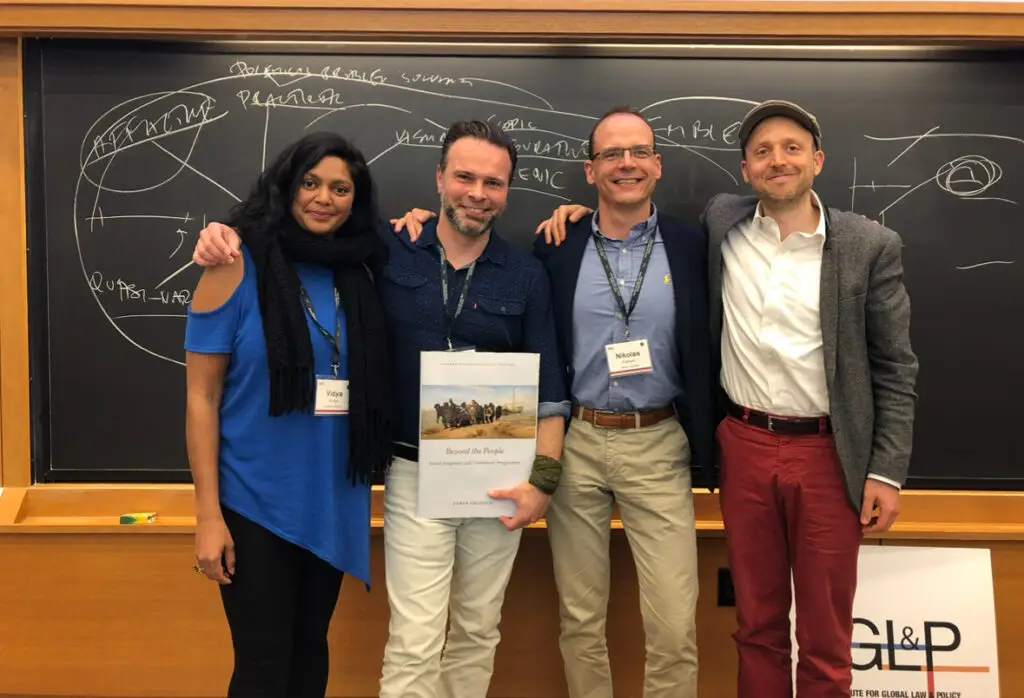



I am Chair of International Law at Tilburg University (The Netherlands), and Senior Faculty at the Institute for Global Law and Policy of Harvard Law School (IGLP). Formerly a practicing attorney, my expertise is genuinely interdisciplinary between International Law, International Relations, and Critical Geography. I was twice awarded “Most Inspiring Teacher” by the students of Tilburg Law School (2019, 2023). My career has spanned six countries and three continents (Asia, Europe and North America).
© All Rights Reserved.